May 07, 2026
ETSI SDG TeraFlowSDN is proud to announce the launch of TFS Release 7. With a broad range of new features spanning P4-device integration, sophisticated automation for multi-granular optical networks, and expanded Northbound Interface (NBI) capabilities, this release positions TeraFlowSDN as the most advanced open-source Network Automation Framework.
The full list of new features for the TFS Controller can be found in Controller Release Notes and NSC Release Notes, for the Network Slice Controller (NSC).
“This release represents a transformative step for TeraFlowSDN as we move beyond traditional control into the era of hyper-programmable and self-healing networks. By successfully integrating closed-loop automation for optical nodes and expanding our support for P4-driven 5G UPF offloading, we are providing operators with the cloud-native tools necessary to manage the extreme dynamicity of B5G and 6G infrastructures.” Ricard Vilalta, CTTC, Chair of SDG.
Key Highlights of TeraFlowSDN Release 7
Advanced P4 Programmability and 5G UPF Support
This release significantly deepens the controller’s integration with P4-programmable hardware, most notably through a new service handler designed for 5G User Plane Function (UPF) offloading providing developers with the granular control necessary for high-performance edge processing and hardware-accelerated networking.
Next-Generation Optical Networking and Automation
TeraFlowSDN continues to lead in optical orchestration by implementing a robust closed-loop automation framework tailored for multi-granular nodes. This update integrates telemetry, KPI management, and analytics to enable self-healing capabilities, while new Northbound Interfaces (NBIs) for Optical Slices and Media Channel Services allow for the automated, flexible provisioning of high-capacity optical links.
Standardised Interoperability and NBI Extensions
To ensure seamless adoption within carrier ecosystems, the release features extensive alignment with industry standards, including IETF NETWORK NBI extensions for IS-IS Traffic Engineering and updated YANG models. Furthermore, the integration of gNMI/OpenConfig SBI drivers for L2VPNs—validated through end-to-end testing with ETSI OSM—ensures that TeraFlowSDN remains a highly interoperable solution for multi-vendor, multi-layer environments.
Enhanced DevOps and Ecosystem Reliability
The latest update prioritises carrier-grade stability with a comprehensive overhaul of the CI/CD pipeline and the introduction of the IETF SIMAP AI-Engine Framework.
Future events
The ETSI SDG TFS#9 Plenary Meeting will take place online on 21 May 2026, bringing an opportunity for new features in TFS Release 7 to be to be presented.
About TeraFlowSDN
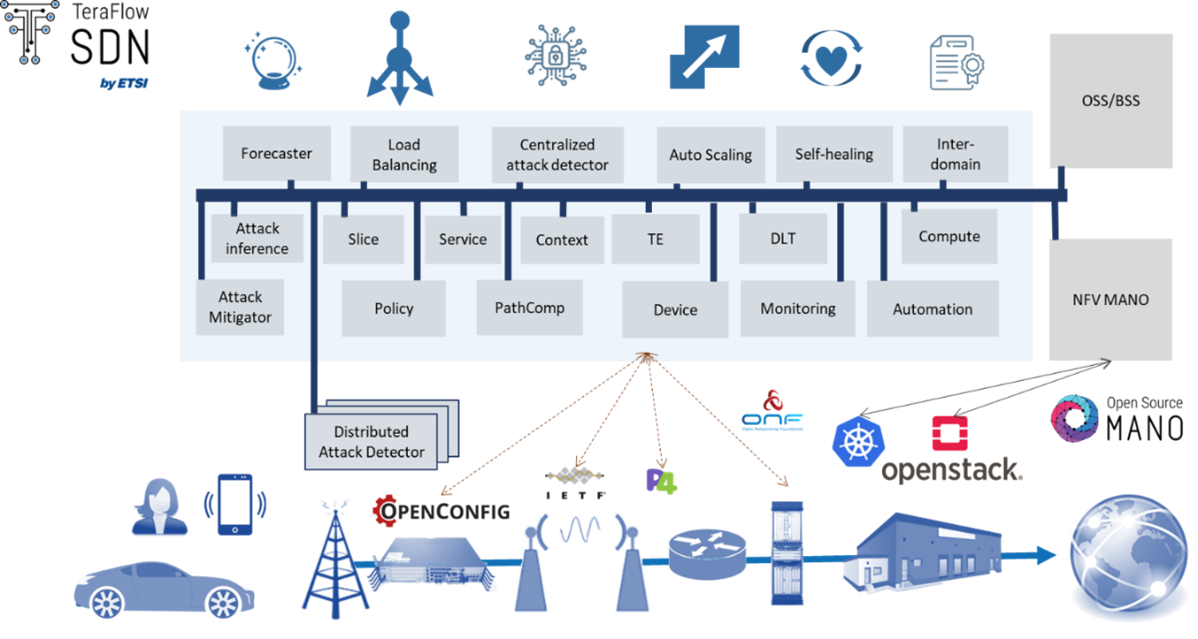
TeraFlowSDN is an advanced open-source network automation framework designed to address the complex requirements of modern high-performance networks. With an emphasis on automation, orchestration, and intelligent resource management, TeraFlowSDN enables service providers and enterprises to optimize their network infrastructures, enhancing scalability, security, and performance.
About ETSI
ETSI provides members with an open and inclusive environment to support the timely development, ratification and testing of globally applicable standards for ICT‑enabled systems, applications and services across all sectors of industry and society. We are a not-for-profit body with more than 900 member organizations worldwide, drawn from 64 countries and five continents. Members comprise a diversified pool of large and small private companies, research entities, academia, government and public organizations. ETSI is one of only three bodies officially recognized by the EU as a European Standards Organization (ESO).